 Footrests are one of the most commonly issued items during Display Screen Equipment (DSE) workstation assessments.
In many workplaces, they are issued automatically when a user’s feet do not reach the floor, often without a full assessment of chair setup, desk height, or the overall workstation configuration.
This approach means equipment is sometimes issued based on visible posture or reported discomfort, rather than understanding why that posture is occurring.
In practice, this can lead to unnecessary DSE equipment provision and missed opportunities to resolve the underlying workstation setup.
In addition, this can result in variation in practice between assessors, where similar workstation setups may lead to different outcomes depending on how the assessment is interpreted. This lack of consistency can affect standardisation across an organisation and create uncertainty in decision-making around equipment provision.
What footrests are actually for?
A footrest provides stable lower limb support when a seated working posture cannot be maintained with appropriate and consistent foot contact with the floor in the working position.
Its purpose is to support a stable seated base where required, not to act as a routine adjustment in standard workstation setups.
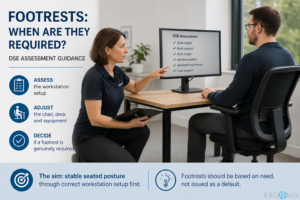
Within DSE assessments, a footrest should only be considered when a stable working posture cannot be achieved through correct workstation setup alone.
In practice, determining whether a footrest is genuinely required depends on the DSE assessor’s ability to correctly interpret workstation setup, chair adjustment sequence, and the relationship between desk height and lower limb support.
This is an area where DSE assessor interpretation can influence outcomes.
The ability to consistently make judgements is what distinguishes basic awareness of DSE guidance from competent assessment practice, where decisions are based on full workstation analysis rather than visible posture alone.
Why foot support matters in seated work?
Foot position contributes to overall seated stability during DSE tasks. When the feet are not supported, the body must adapt to maintain balance in the chair, often resulting in compensatory strategies such as sitting forward on the chair, crossing the legs, or slouching to reach the floor. This can influence pelvic position and how the upper body is controlled during sustained screen-based work. Over time, reduced lower limb stability can increase reliance on muscular effort to maintain posture, particularly during prolonged static sitting. Foot support therefore contributes to whole-body seated stability, not just lower limb comfort.
Simple DSE check: when is a footrest required?
To determine if a footrest is required:
- Consider whether the desk is fixed or adjustable when setting chair height
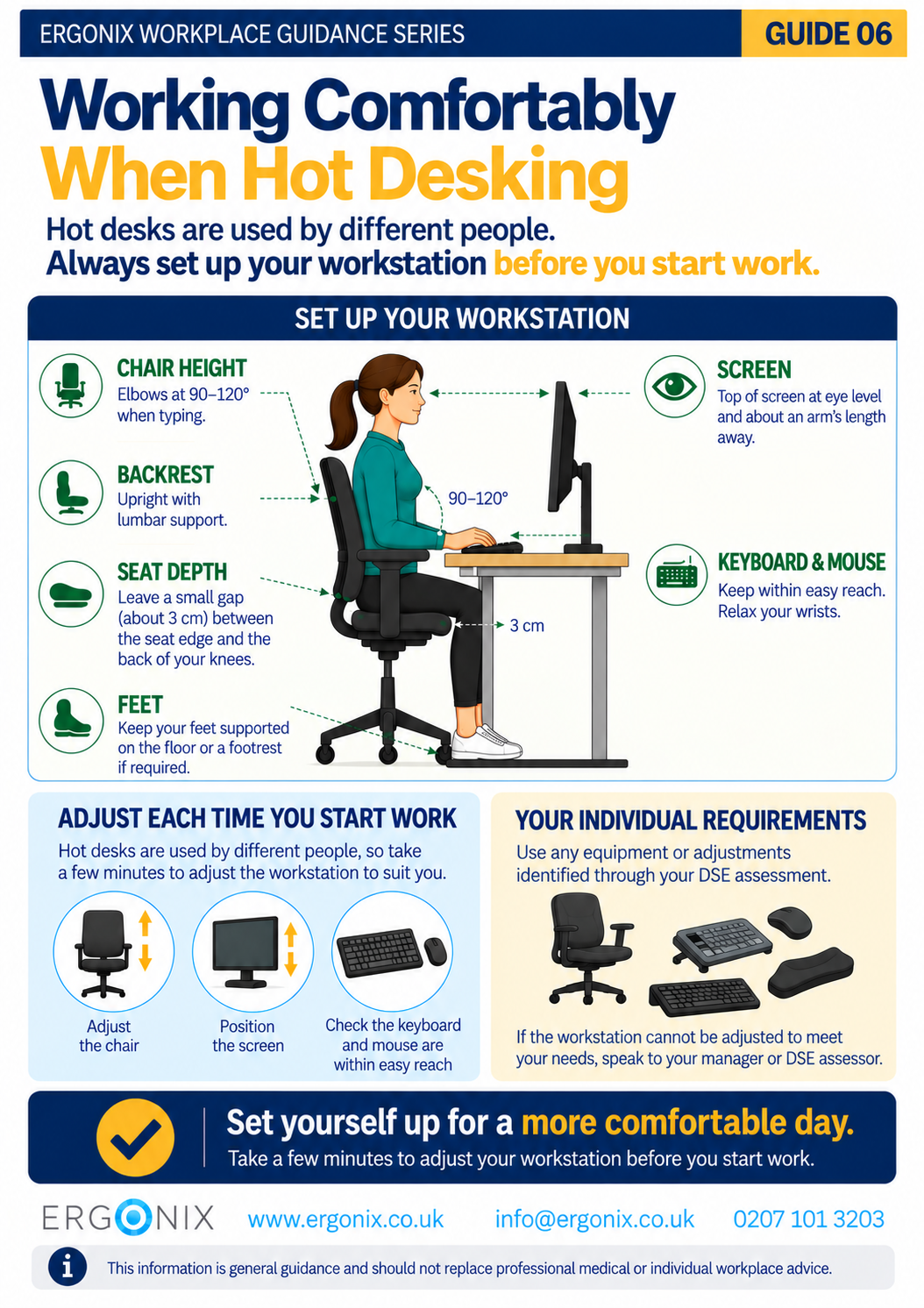
- Adjust the chair to fit the DSE user first (if it’s not a sit-stand desk)
- Elevate the chair height so elbows are level with the desk surface and shoulders relaxed (elbows at 90–120 degrees flexion)
- Adjust the back rest to an upright position, adjust the lumbar spine position and then the arm rests
- In this position, assess whether the feet can be placed flat on the floor
- If feet cannot be supported flat while maintaining correct working chair height, a footrest is required to maintain stable seated posture
- Take into consideration footwear. A change in footwear (e.g. heels vs flat shoes) may therefore change the need for a footrest or require the footrest height to be adjusted
Key point for DSE assessors and employers
Footrests should not be issued as a default response when feet do not reach the floor, as this often reflects inconsistent assessment practice rather than a true workstation requirement.
They should only be introduced when:
- The chair and desk setup has been correctly considered and adjusted
- A stable seated posture cannot be maintained without additional lower limb support
Understanding this distinction is a key component of DSE assessment practice and is commonly addressed in DSE assessor training.
This ensures equipment provision remains appropriate, targeted, and consistent with good ergonomic practice.
What to look for in a footrest
Where a footrest is required, suitable features include:
- Adjustable height to suit different users and footwear
- Stable, non-slip base to maintain consistent positioning
- Tilt or movement capability to allow subtle postural variation during use
The aim is to support stability while allowing natural micro-adjustments during work.
Conclusion
Footrest use should always be based on whether stable seated posture can be achieved once the workstation has been correctly set up.
When used appropriately, they support postural stability during screen-based work. When used automatically, they risk diverting attention away from the true causes of workstation imbalance.
Consistently making these judgements requires training in DSE workstation setup. It relies on understanding DSE assessment principles, how to select appropriate equipment, and how small changes in posture or workstation configuration influence overall risk.
This decision-making is developed during the DSE Workstation Assessor Course, which trains delegates to assess workstation setup consistently and confidently, including when equipment such as footrests is and isn’t required.
Frequently asked questions
Are footrests always required when feet do not reach the floor?
No. A footrest is required when a stable seated posture cannot be maintained after correct chair and DSE workstation setup.
What is the purpose of a footrest in DSE assessments?
To provide stable lower limb support to maintain supported seated working posture.
Can footwear affect whether a footrest is needed?
Yes. Different footwear (e.g. heels vs flat shoes) can affect whether the feet sit flat on the floor once the chair is correctly set, which may influence the need for a footrest.
Related articles:
Should Office Chair Armrests Be Removed? A DSE Assessment Guide
Ergonomic Best Practices for Using Multiple Screens in the Workplace
Digital Eye Strain: What Employers Need to Know About Eye Health and Workstations
Simple Desk-Based Stretches to Help Reduce Employee Musculoskeletal Complaints
Author: Angela Yates | Workplace Health, Wellbeing & Ergonomics Specialist | HCPC-Registered Physiotherapist
Review date: 2026