 Hot desking has become a widely adopted feature of hybrid working across the UK. As organisations continue to optimise office space based on fluctuating attendance, shared workstation models are increasingly replacing traditional assigned desks.
While this approach is often introduced as a practical response to hybrid working, it significantly changes how employees interact with their workstation on a day-to-day basis. From an ergonomics and DSE perspective, this introduces variability that can directly influence comfort, posture and musculoskeletal wellbeing if not effectively managed.
What hot desking means in practice
Hot desking refers to a workplace model where employees do not have a permanently assigned workstation. Instead, desks are shared and may be:
- selected on arrival in the office
- booked in advance using a desk booking system
The aim is typically to improve space efficiency and reflect reduced office occupancy in hybrid working models. However, this also introduces inconsistency in workstation setup, which is a key ergonomic consideration.
Why organisations are adopting hot desking
The primary driver for hot desking is usually space utilisation and cost efficiency. With fewer employees in the office on any given day, fixed desk allocation is often seen as inefficient, leading organisations to adopt more flexible seating arrangements such as hot desking.
This can result in:
- reduced office space requirements
- reduced need for duplicate furniture and fixed workstation setups
- potentially reduced energy consumption depending on usage patterns
- more adaptable use of workspace
There is also an expectation that shared seating may support collaboration by increasing interaction between teams and departments.
The ergonomic challenge: variability of workstation setup
From a DSE and ergonomics perspective, the main challenge with hot desking is inconsistency of setup.
Unlike a fixed workstation environment, employees may use a different desk, chair or screen arrangement each day. Even where equipment is adjustable, baseline configurations can vary significantly between workstations.
This means employees are required to:
- repeatedly adjust workstation settings
- adapt to unfamiliar layouts
- reconnect or reposition equipment
- work in environments that may not be optimally configured
Over time, this variability can impact postural consistency and increase physical strain during office-based working.
Impact on musculoskeletal comfort and wellbeing
A common trend observed in hot desking environments is an increase in reported musculoskeletal discomfort during office days.
This may present as:
- neck and shoulder tension
- upper back and postural fatigue
- lower back discomfort
- increased physical strain during prolonged sitting periods
These symptoms are often associated with inconsistent workstation setups and reduced familiarity with equipment adjustment. Even in environments with height-adjustable desks and modern equipment, uncertainty around correct setup can influence comfort and posture.
Access to adjustments and individual requirements
One of the less visible impacts of hot desking is reduced consistency in access to personalised workstation setups.
In a fixed desk environment, employees may have:
- a specific chair or seating adjustment
- a configured screen setup
- additional ergonomic equipment
- a workstation tailored to their needs
In shared environments, this consistency can be lost. This is particularly relevant for employees who require:
- specific seating or equipment adaptations
- quieter or low-distraction working areas
- proximity to facilities
- predictable workstation conditions due to health or neurodiversity-related needs
Without clear management processes, employees may be unclear on how to maintain or request appropriate adjustments.
Stress and workplace experience
Hot desking also introduces additional daily cognitive load that is not present in fixed workstation environments.
This may include:
- locating an available desk
- checking equipment functionality
- setting up the workstation each day
- locating colleagues working in different areas or locations
For some employees, this creates uncertainty at the start of the working day, which can contribute to increased stress and reduced ease of transition into work tasks.
What organisations often overlook
Many of the challenges associated with hot desking are not caused by the model itself, but by implementation.
Common gaps include:
- inconsistent workstation configurations across desks
- limited guidance on correct DSE equipment adjustment
- unclear reporting routes for discomfort or equipment issues
- lack of visibility of available ergonomic accessories
- absence of defined support for employees with specific requirements
When these elements are not addressed, variability becomes a predictable outcome rather than an unintended consequence.
Key considerations for effective hot desking environments
Several practical factors influence how effectively hot desking functions from an ergonomic perspective.
Consistency of workstation design
Where possible, desks should be configured consistently to reduce variability between workstations.
Access to equipment guidance
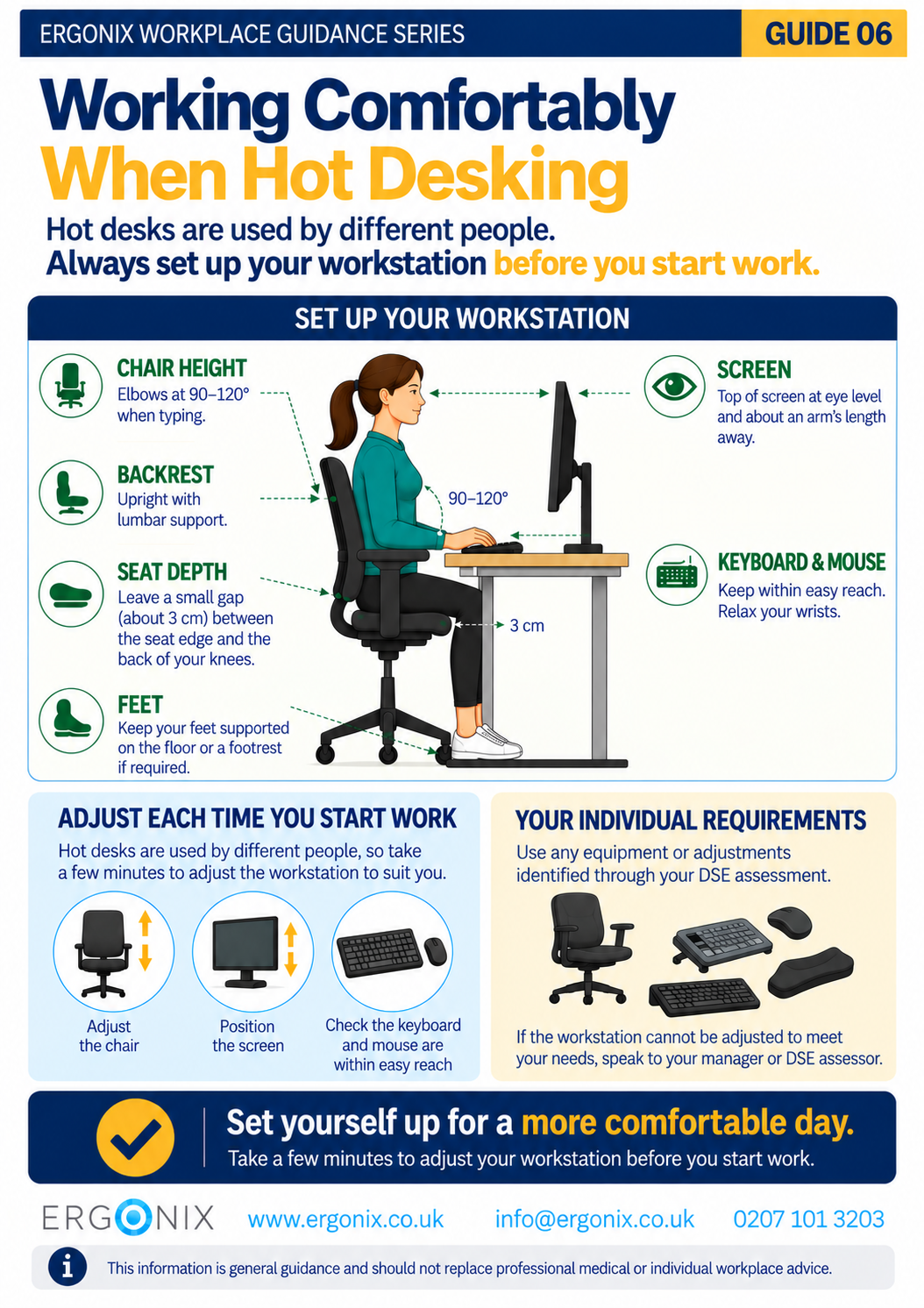
Clear instructions should be available to ensure employees understand how to adjust chairs, screens and desks correctly in unfamiliar environments.
Access to support equipment
Items such as footrests, document holders and alternative seating options should be easily accessible and clearly located.
Inclusion of individual requirements
Where required, specific workstation arrangements should remain available within shared environments.
DSE risk assessment
DSE assessments should consider variability across different workstations, not just fixed desk environments, to ensure individual needs are appropriately identified and managed.
DSE training aligned to hybrid working
Training should reflect hot desking environments so employees can confidently set up unfamiliar workstations and reduce ergonomic risk.
Final reflection
Hot desking is not inherently positive or negative from an ergonomics perspective. Its impact depends on how consistently it is implemented and how effectively individual needs are considered within shared working environments.
Where variability is unmanaged, it can influence comfort, productivity and overall workplace experience. Where it is well planned and supported, it can operate effectively within hybrid working models.
In most cases, the difference lies not in the concept itself, but in the detail of workstation setup, DSE training and ongoing ergonomic risk management.
Supporting hot desking environments
In many organisations, hot desking is supported through a combination of DSE assessment processes, DSE training and workplace wellbeing interventions.
DSE assessments help ensure that individual workstation requirements are identified and maintained, even where employees use different desks on different days. This supports consistency in posture, comfort and equipment use across shared environments.
DSE training for employees and assessors can improve consistency by enabling users to correctly set up unfamiliar workstations and understand key ergonomic principles.
Some organisations also introduce workplace wellbeing and musculoskeletal health workshops to support employees in managing the physical demands of hybrid working. These typically focus on practical strategies to improve comfort, reduce strain and build awareness of daily workstation habits.
Further information on DSE assessments, DSE assessor training, wellbeing workshops and workplace wellbeing support is available on request via the Contact Us page.
Related articles:
Further practical guidance on workstation setup and employee posture can be found in our related article on hot desking ergonomics and posture.