A practical guide to the different types of DSE assessments and how they support workplace health, safety, and compliance.
 Ensuring individuals work safely at their DSE (Display Screen Equipment) workstation is essential for long-term health, wellbeing, productivity and reduced absence. A DSE assessment is a structured review of an individual’s workstation, environment and working practices to identify risks and implement suitable adjustments. These assessments are a key tool in preventing musculoskeletal injuries, supporting user comfort and maintaining health and safety compliance. However, not all DSE assessments are the same, and organisations need a practical approach to get the most from them and meet legal obligations. In practice, the effectiveness of DSE assessments often depends on how they are implemented and followed up on.
Understanding the Different Types of DSE Assessments
In practice, DSE assessments can take several forms, each serving a specific purpose:
1.Self-Assessments for DSE Workstations
DSE self-assessments are completed by the individual user to review their own workstation, including posture, workstation setup, equipment use, environment and working habits. They are typically delivered via online tools or paper-based forms and can help raise awareness of common DSE risks.
Many organisations rely heavily on self-assessment alone, which can lead to inconsistent outcomes and risks being overlooked.
When designed effectively and supported by appropriate information, instruction and training, self-assessments can help users identify a range of risks and make practical improvements to their workstation. They also play an important role in increasing awareness of ergonomics and good working practices.
Under the Health and Safety (Display Screen Equipment) Regulations 1992 (as amended), employers are required to ensure that DSE users are provided with suitable information, instruction and training, alongside an appropriate assessment of their workstation.
Where self-assessments are used, training helps users recognise potential risks and complete assessments effectively. When responses indicate areas requiring further review, these should be followed up with a more detailed assessment by a trained DSE assessor to ensure risks are appropriately addressed and reduced.
DSE self-assessments also have limitations, including the potential to overlook more complex ergonomic issues, reliance on the user’s knowledge and understanding, the absence of professional verification of findings, and variation in the quality and consistency of responses.
2. Internal DSE Assessor: Benefits and Best Practices
Organisations can train internal staff to carry out workstation assessments. These assessors receive comprehensive DSE training, typically through accredited DSE training courses.
Once trained, internal assessors can provide immediate, personalised guidance, identify workstation risks, and support employees in making practical, evidence-based adjustments. This helps ensure a consistent approach across the organisation and enables findings from self-assessments to be reviewed in more detail where needed.
Internal assessors play an important role in bridging the gap between initial self-assessments and more detailed expert evaluations, helping organisations manage workstation risks effectively. Alternatively, organisations may choose to use internal assessors as their primary method of assessment instead of relying on DSE self-assessments.
3. Specialist Ergonomic Assessments for Complex DSE Needs
For complex cases, users with existing health conditions, larger-scale workplace programmes, or when previous assessment methods have identified ongoing concerns requiring further review, specialist DSE assessments can provide a more in-depth evaluation.
These assessments are carried out by specialist assessors, typically professionals with medical qualifications and additional training in DSE, such as physiotherapists, occupational health professionals, or ergonomists.
A specialist can review workstation design, individual health considerations, and workflow patterns to provide tailored recommendations that help reduce risk, improve comfort, and support effective performance.
Why Different DSE Assessments Matter
Not every user requires a specialist assessment, but relying solely on self-assessment can leave risks unaddressed. By combining these approaches:
- Self-assessments raise awareness and help identify obvious issues early.
- Trained internal DSE assessors follow up on self-assessments when needed, providing personalised guidance, supporting consistency, and helping to ensure compliance.
- Expert evaluations address complex cases and support organisational best practice.
This layered approach ensures that all DSE users receive appropriate support, from routine guidance through to specialist intervention.
Making DSE Assessments Work in Your Organisation
Practical strategies to maximise engagement, compliance, and outcomes include:
- Integrate DSE into induction – set expectations early for new hires.
- Train internal DSE assessors – develop in-house capability for faster, consistent assessments.
- Provide DSE workshops and guidance – show users why adjustments matter and how to implement them.
- Offer regular breaks or changes of activity – reduce prolonged screen use to protect musculoskeletal and mental health.
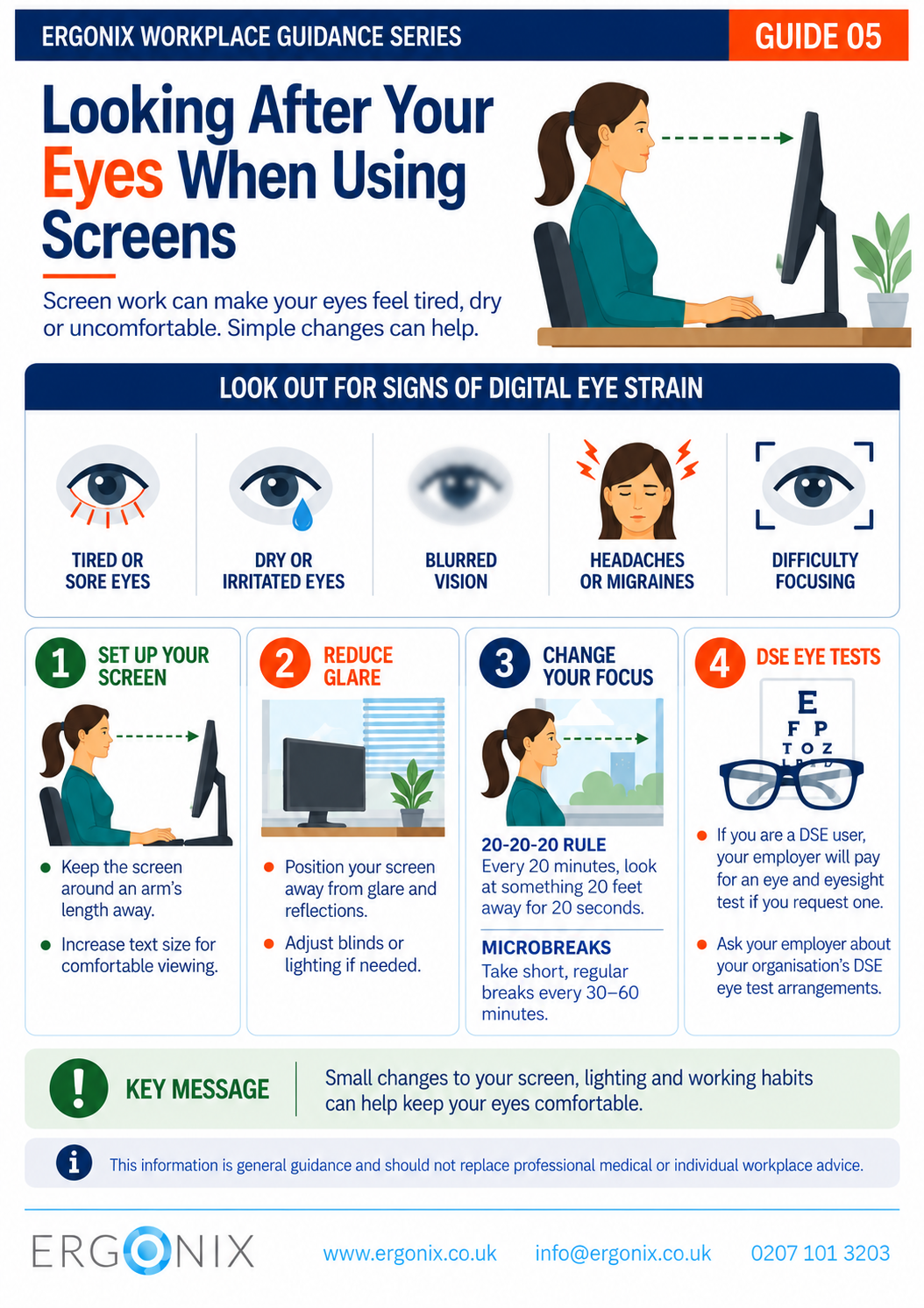
- Support eye-health – ensure users are aware of how to access eye and eyesight tests, and that processes are in place for timely assessment by a competent professional.
- Use a phased rollout for larger organisations – manage the process efficiently and ensure thorough coverage.
- Focus on prevention – emphasise musculoskeletal health and wellbeing, not just DSE compliance.
- Support remote and hybrid workers – ensure that all users, regardless of location, receive appropriate assessment and guidance.
- Maintain clear records of DSE workstation assessments and actions – ensuring assessments are documented, reviewed, and updated where changes occur, supports accountability and ongoing risk management.
A structured DSE programme that blends self-assessment, internal checks, and expert review helps organisations protect health, prevent injuries, and foster a culture where wellbeing is embedded into daily work.
If you would like to discuss employee wellbeing workshops, DSE assessments or our CIEHF-accredited DSE assessor training courses, further information and practical support can help your organisations develop an effective, compliant and user-focused DSE programme.
Frequently Asked Questions about DSE Assessments
What is a DSE assessment?
A DSE (display screen equipment) assessment is a review of an individual’s workstation, working environment and working practices to identify risks and recommend suitable adjustments. It is used to help reduce the risk of musculoskeletal issues and support user comfort and compliance with UK health and safety regulations.
Who needs a DSE assessment?
DSE users who habitually use display screen equipment as a significant part of their work, typically involving regular daily use and continuous periods (often around an hour or more at a time).
What are the different types of DSE assessments?
There are generally three types:
- Self-assessments completed by the user
- Internal DSE assessor evaluations carried out by trained staff
- Expert ergonomic assessments conducted by specialists
Is a DSE self-assessment enough on its own?
A DSE self-assessment can identify basic risks, but if any issues are found, a further assessment or action is required to address them.
What is the role of an internal DSE assessor?
An internal DSE assessor is a trained individual within an organisation who reviews workstation assessments, provides guidance, and helps ensure consistency in how risks are identified and managed across the workforce.
When is a specialist DSE assessment needed?
A specialist DSE assessment is typically used when there are complex workstation issues, ongoing discomfort, existing health conditions, or when previous assessments have not resolved the problem. These assessments provide more detailed, tailored recommendations.
By Angela Yates | Workplace Health, Wellbeing & Ergonomics Specialist | HCPC-Registered Physiotherapist